


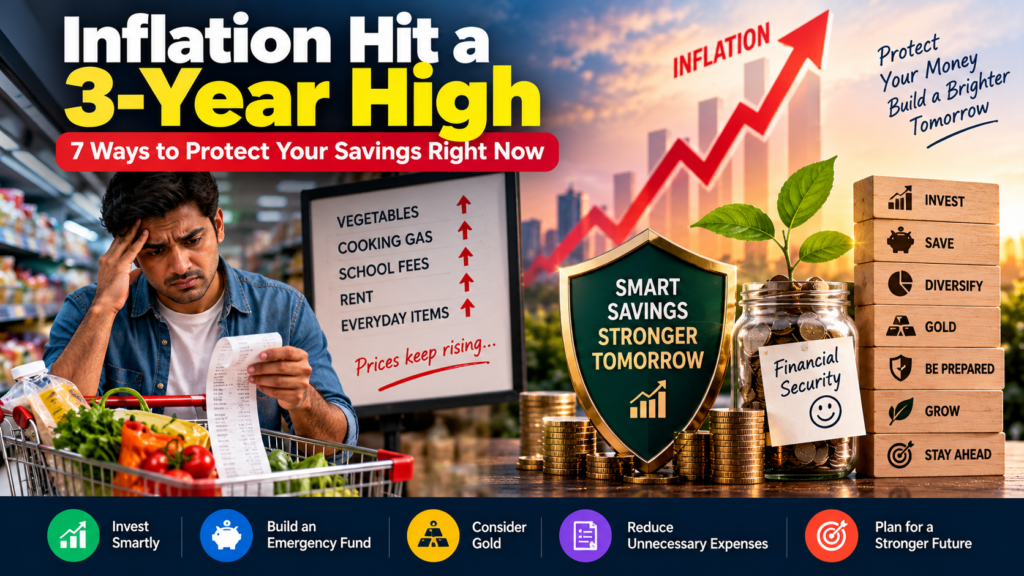
You checked your grocery bill this month and it felt heavier than your college backpack on exam day. Same items, same quantity, but the total somehow jumped again. If your salary has stayed flat while everything around it vegetables, cooking gas, school fees, rent keeps climbing, you are not imagining things. Inflation has quietly become the most expensive habit you never signed up for.
With inflation touching a three-year high, the real question is not “why is this happening” it is “what do I do about my money right now.” This article breaks down seven practical, India-specific ways to protect your savings before inflation eats further into your purchasing power.
Quick Answer
To protect your savings during high inflation, move idle cash out of low-interest savings accounts and into a mix of inflation-beating instruments equity mutual funds, debt funds, gold, and inflation-indexed options while trimming discretionary expenses and building a 6-month emergency fund. The goal is simple: make your money grow faster than prices are rising, not just park it safely while it quietly loses value.
Key takeaway: High inflation reduces the real value of money sitting idle in savings accounts or low-yield fixed deposits. Protecting your savings means actively reallocating funds toward assets that historically outpace inflation, while keeping enough liquidity for emergencies.
What Does “Inflation at a 3-Year High” Actually Mean?
Inflation at a three-year high means the general price level of goods and services is rising faster than it has in the last three years, shrinking how much your rupee can actually buy.
In practical terms, if inflation is running at 7% and your savings account gives you 3% interest, your money is losing roughly 4% of its real value every year. You still see the same number in your bank balance, but it buys less rice, less petrol, and less school uniform fabric than it did twelve months ago.
Why Does Inflation Suddenly Spike?
Inflation typically spikes due to a mix of rising fuel and commodity prices, supply chain disruptions, increased consumer demand, and currency depreciation.
For Indian households, imported crude oil prices and monsoon-driven food price shocks are two of the biggest and most recurring triggers. When onions or tomatoes suddenly triple in price during an erratic monsoon, that is inflation showing up on your dinner plate before it shows up in any economic report.
How Does Inflation Actually Damage Your Savings?
Inflation damages savings by silently reducing their purchasing power even when the account balance looks unchanged or grows slightly through interest.
Consider Priya, a 28-year-old marketing executive in Pune, who kept ₹5 lakh in a savings account earning 3% annual interest. With inflation running at 6.5%, her money’s real value actually declined by about 3.5% that year. On paper she had more rupees. In reality, she could buy noticeably less with them from her monthly kirana bill to her annual health checkup package.
This is the core problem: cash sitting idle is not “safe,” it is slowly leaking value.
7 Ways to Protect Your Savings During High Inflation
Below are seven practical, actionable steps you can start this week, not “someday.”
1. Stop Overfunding Your Savings Account
Direct answer: Keep only 3-6 months of expenses in your savings account; move the rest into higher-yield instruments.
Most people treat their savings account like a warehouse instead of a waiting room. Money should pass through it, not settle down permanently. Anything beyond your emergency buffer is losing real value every single day it sits there earning 2.5-3.5% while inflation runs higher.
2. Use Equity Mutual Funds for Long-Term Goals
Direct answer: Equity mutual funds, especially through SIPs, have historically outpaced inflation over 7-10 year periods, making them suitable for long-term wealth building.
Equity is volatile in the short term there will be red months, sometimes red years. But history shows that over longer horizons, equity has generally delivered returns well above inflation, unlike fixed deposits. Starting or increasing your SIP amount is one of the most direct hedges against long-term inflation.
A simple example: Ramesh, a 32-year-old software engineer in Bengaluru, increased his monthly SIP by just ₹2,000 after seeing his rent hike this year. He didn’t try to time the market he simply automated a slightly bigger habit.
3. Add Debt Funds and Fixed Income Strategically
Direct answer: Short-duration debt funds and target maturity funds can offer better post-tax, inflation-adjusted returns than traditional fixed deposits in certain rate environments.
Not everything should go into equity. Debt instruments provide stability and are essential for short-to-medium-term goals like a wedding fund or a car down payment. The key is choosing the right duration based on your goal timeline, not just picking whatever your bank relationship manager pushes.
4. Hold Gold as an Inflation Hedge Not an Emotional Purchase
Direct answer: Gold has traditionally acted as a hedge against inflation and currency depreciation, and can be held through Sovereign Gold Bonds or Gold ETFs instead of physical jewellery.
Indian households already love gold, but jewellery comes with making charges and storage risk. Sovereign Gold Bonds (SGBs) give you gold-linked returns plus periodic interest, making them a smarter inflation hedge than a locker full of ornaments you rarely wear.
5. Consider Inflation-Indexed and Government-Backed Instruments
Direct answer: Instruments like the Public Provident Fund (PPF) and certain government schemes offer relatively stable, tax-efficient returns that help preserve capital during inflationary periods.
These won’t make you rich overnight, but they anchor your portfolio with predictability. PPF, in particular, combines a decent interest rate with tax benefits under the old regime, making it a solid long-term inflation buffer for conservative savers.
6. Cut Lifestyle Inflation Before It Cuts You
Direct answer: Reviewing and trimming discretionary spending subscriptions, food delivery, impulse shopping frees up money that can be redirected into inflation-beating investments.
This is the least glamorous but most immediate fix. Ask yourself: how many OTT subscriptions are you actually watching? How many food delivery orders happen out of laziness, not hunger? Redirecting even ₹3,000-5,000 a month from lifestyle leaks into a SIP compounds meaningfully over time.
7. Build (or Rebuild) a Real Emergency Fund
Direct answer: A properly funded emergency fund prevents you from breaking long-term investments or taking high-interest loans when inflation-driven expenses spike unexpectedly.
When prices rise suddenly medical costs, fuel, school fees households without a buffer often end up borrowing at high interest or redeeming investments at the wrong time. A 6-month expense buffer in a liquid fund or sweep-in FD protects your long-term investments from being disturbed during short-term shocks.
Comparing Your Options at a Glance
| Instrument | Inflation-Beating Potential | Liquidity | Best For |
|---|---|---|---|
| Savings Account | Low | High | Emergency buffer only |
| Fixed Deposit | Low-Moderate | Moderate | Short-term safety |
| Debt Mutual Funds | Moderate | High | 1-3 year goals |
| Equity Mutual Funds (SIP) | High (long-term) | High | 7+ year goals |
| Sovereign Gold Bonds | Moderate-High | Low (locked-in) | Portfolio diversification |
| PPF | Moderate | Low (long lock-in) | Long-term, tax-efficient saving |
How Much of My Savings Should Go Into Each Option?
Direct answer: A common starting approach is the 3-bucket method emergency fund, short-term goals, and long-term growth allocated based on your age, income stability, and goals rather than a fixed universal percentage.
Someone in their late 20s with stable income might lean more heavily into equity, while someone nearing retirement would prioritize capital protection through debt instruments and PPF. There is no single “correct” percentage the right mix depends on your personal risk appetite and timeline.
A Quick Reality Check
None of these strategies promise guaranteed returns, and none of them work overnight. Markets fluctuate, interest rates change, and even gold has flat years. The goal is not to chase the highest return it is to stop your money from silently losing value while you wait for “the right time” to start.
This article is for general educational purposes and does not constitute personalized financial advice. Please assess your own risk profile, goals, and consult a certified financial advisor before making investment decisions.
Frequently Asked Questions
Does inflation affect fixed deposits negatively? Yes if your FD interest rate is lower than the current inflation rate, your money’s real value decreases even though the account balance grows nominally.
Is gold really a good hedge against inflation in India? Gold has historically preserved value during high-inflation periods, but it should be one part of a diversified portfolio rather than the only inflation strategy.
Should I stop my SIP if inflation is high? No SIPs are designed to work through market cycles, and continuing them during inflationary periods often helps you buy more units when markets dip, benefiting long-term returns.
How much emergency fund do I need during high inflation? Most financial planners suggest 6 months of essential expenses, though some prefer extending it to 9-12 months during periods of higher economic uncertainty.
Your Next Step
Don’t wait for a “better financial year” to start protecting your money inflation isn’t waiting either. Open your investment app this weekend and increase your existing SIP by even ₹1,000, or start one if you haven’t already. That single five-minute action today is worth more than a month of overthinking tomorrow.