


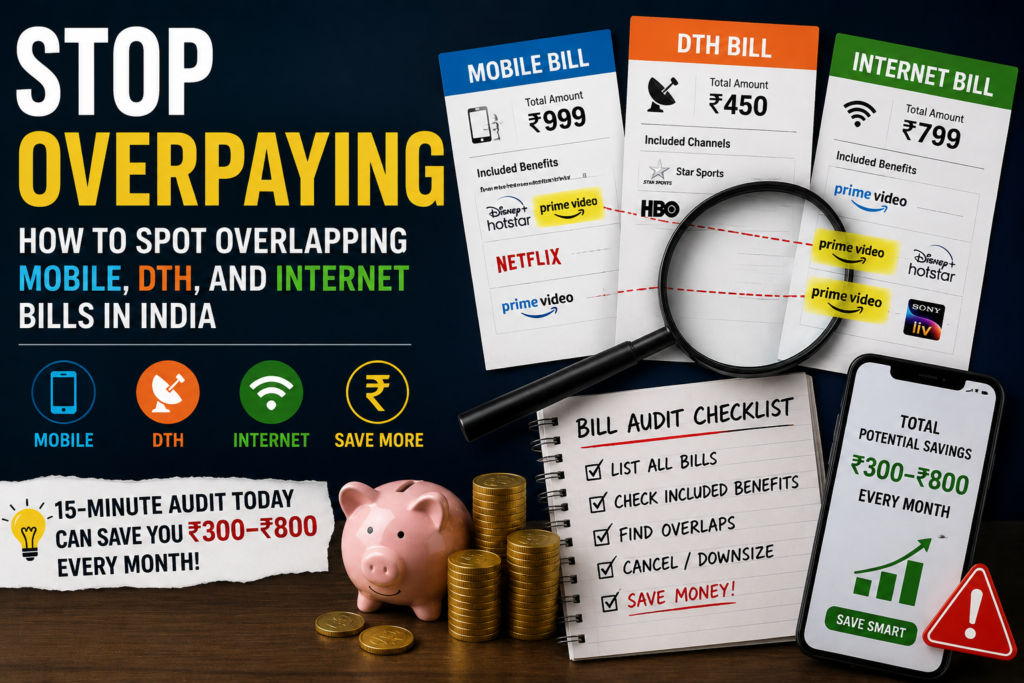
Key takeaway: Most Indian households unknowingly pay for the same entertainment, data, or connectivity twice through a mobile recharge plan, a DTH subscription, and a broadband bundle that all include similar OTT apps, data quotas, or channel packs. A quick 15-minute audit of your last three bills, matched against what you actually use, can reveal ₹300–₹800 a month in avoidable spending.
If you’ve never sat down and compared your mobile bill, your DTH recharge, and your broadband invoice side by side, you’re not alone. I hadn’t either, until a friend pointed out that I was paying for Disney+ Hotstar through my Jio postpaid plan and separately through my broadband bundle. That one overlap alone was costing me nearly ₹300 a month for nothing.
This is more common than people think. Telecom and DTH operators in India have gotten very good at bundling and bundling, while convenient, is also where duplicate charges hide.
Why Overlapping Bills Happen So Easily
Indian telecom players don’t just sell you a SIM card or a set-top box anymore. They sell you an entire ecosystem mobile recharge, home broadband, DTH, and OTT subscriptions often from the same parent company or through partner tie-ups.
A few reasons overlaps sneak in:
- Auto-renewed add-ons: A promotional OTT pack added six months ago at ₹1 that quietly renewed at full price.
- Bundled plans from the same provider: Airtel, Jio, and Tata Play frequently push combo plans where a mobile recharge already includes an app or channel pack you’re also paying for separately.
- Family SIMs with individual OTT access: Each family member’s SIM includes the same streaming subscription, when one shared login would do.
- DTH channel packs that duplicate broadband OTT bundles: You might be paying for a sports channel pack on DTH while your broadband plan already gives you the same content through an app.
None of this happens because the companies are being dishonest it’s simply that plans change, offers expire, and nobody sends you a reminder saying “hey, you’re now paying twice for the same thing.”
The Real Cost of Not Checking
A single overlapping subscription might look small on paper ₹150 here, ₹250 there. But personal finance isn’t about single transactions; it’s about patterns.
Consider a fairly typical urban household:
| Service | Monthly Cost | Includes |
|---|---|---|
| Mobile postpaid family plan | ₹999 | Disney+ Hotstar, Netflix basic |
| DTH subscription | ₹450 | Sports pack, entertainment pack |
| Broadband plan | ₹799 | Amazon Prime, Disney+ Hotstar |
Notice Disney+ Hotstar appears twice. That’s roughly ₹250–₹300 wasted every month, or upward of ₹3,000 a year money that could instead go into a recurring deposit, an emergency fund, or even a small SIP.
This is the kind of leak that doesn’t show up as a shock on your bank statement. It just quietly erodes your monthly budget, month after month, until you actually sit down and look.
Step-by-Step: How to Audit Your Bills for Overlaps
Here’s the exact process I now follow every few months. It takes less time than watching an episode of a show you’re probably already overpaying to access.
Step 1: Pull Your Last Three Bills
Get your mobile, DTH, and broadband bills or app statements from the last three billing cycles. Most providers (Jio, Airtel, Vi, Tata Play, Dish TV, ACT, BSNL) let you view this in their app under “billing history” or “usage details.”
Step 2: List Every “Included Benefit”
Next to each bill, write down every add-on or benefit mentioned OTT apps, channel packs, cloud storage, insurance add-ons, roaming packs. Don’t skip the fine print; this is usually where duplicates live.
Step 3: Cross-Match Across Services
Now compare the three lists. Ask yourself:
- Is the same OTT platform listed under more than one bill?
- Are there two subscriptions giving you access to the same sports or entertainment channels?
- Is a data add-on on your mobile plan duplicating what your broadband already covers (like a mobile hotspot pack when you’re rarely away from home Wi-Fi)?
Step 4: Check What You Actually Use
This step matters as much as spotting overlaps. Open each app and check your last login date. A subscription you’re paying for but haven’t opened in two months is functionally the same as a duplicate — it’s money leaving your account for zero value.
Step 5: Cancel, Downgrade, or Consolidate
Once you’ve identified the overlap, you generally have three choices:
- Cancel the standalone subscription if it’s already bundled elsewhere.
- Downgrade your plan to a version without the duplicate add-on, if the provider allows partial customization.
- Consolidate providers some households find it cheaper to get mobile, broadband, and OTT from a single provider’s combo plan rather than three separate ones.
A Quick Real-World Example
When I did this audit for my own household, here’s what I found:
- My mobile postpaid plan included Amazon Prime Video, which I was rarely using.
- My broadband plan, added a year earlier, also included Amazon Prime as part of a promotional bundle.
- Separately, I had a personal Prime subscription linked to my card, active since before either bundle existed.
Three subscriptions. One service. That’s an extreme case, but it’s exactly why doing this check periodically not just once — matters. Plans change, promotions expire, and old subscriptions don’t cancel themselves.
Common Signs You’re Overpaying
You’re likely dealing with overlapping bills if any of these sound familiar:
- You genuinely can’t remember why a certain amount was auto-debited last month.
- You have more than one OTT subscription active for the same platform (personal login plus a bundled one).
- Your DTH bill includes a sports or movie pack you also get through a mobile or broadband OTT bundle.
- You upgraded your broadband plan for speed but didn’t check what extra “benefits” came bundled with it.
- Family members each have individual data or OTT add-ons instead of a shared plan.
Building a Habit Around This
A one-time audit helps, but the real value comes from making this a habit. A simple approach:
- Set a recurring reminder every three months to review your recharge and billing apps.
- Keep a basic note (even a phone notes app works) listing what each connection includes.
- Before accepting any “free trial” or “special offer” add-on, note the date it will start charging you, so it doesn’t quietly become a permanent overlap.
This isn’t about being paranoid over ₹100 subscriptions. It’s about building the same discipline you’d apply to any other part of your monthly budget because collectively, these small recurring charges behave a lot like silent EMIs you never signed up for.
A Word of Caution
Every household’s telecom and DTH setup is different, and providers frequently update their plans and bundled offers. The examples and cost figures above are illustrative, not fixed numbers you should expect to match exactly. Always verify current plan details directly with your service provider before cancelling or switching, since early termination or plan-change charges may apply. This article is meant to guide your thinking, not replace a look at your own actual bills.
Frequently Asked Questions
How often should I check my mobile, DTH, and broadband bills for overlaps? Once every three months is a reasonable rhythm. Plans and promotional bundles change often enough that a yearly check can miss several months of unnecessary charges.
Is it worth switching to a single provider for mobile, DTH, and broadband? It can be, if the combined plan genuinely covers what you use without adding new overlaps. Compare the total combo cost against your current separate bills line by line before switching, rather than assuming a bundle is automatically cheaper.
What’s the easiest way to track OTT subscriptions bundled with telecom plans? Check your provider’s app under “my benefits” or “active add-ons,” and cross-check against the OTT app itself, which usually shows how your subscription is linked (personal, bundled, or through a partner offer).
Can cancelling a bundled OTT subscription affect my mobile or broadband plan? Sometimes bundled OTT access is tied to the plan tier itself, so removing it might mean downgrading the whole plan rather than just the add-on. Check the plan terms with your provider before making changes, so you don’t lose other benefits you actually use.
Pick just one bill this week mobile, DTH, or broadband and match its “included benefits” against what you’re paying for elsewhere. That single 15-minute check is usually enough to find your first overlap.