
If you’ve ever looked at your bank statement at the end of the month and wondered where all your salary disappeared, you’re not alone. Most middle-class Indian households don’t lose money to one big mistake they lose it to small, invisible leaks that add up quietly, month after month.
Quick summary: The biggest money leaks for Indian households usually come from unused subscriptions, high-interest debt, impulse buying through food delivery and quick-commerce apps, poor insurance choices, idle savings account balances, and small daily convenience spends. Fixing even three or four of these can free up several thousand rupees every month without touching your lifestyle drastically.
This article walks through seven of the most common leaks, why they happen, and how to plug them without feeling like you’re depriving yourself.
1. Subscriptions You Forgot You’re Paying For
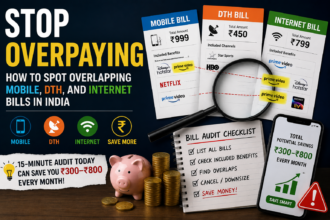
This is the classic one. Between OTT platforms, music apps, cloud storage, fitness apps, and that one magazine subscription you signed up for during a festive sale, most families are paying for at least five to seven recurring services.
The tricky part is that these charges are usually small individually ₹149 here, ₹299 there so they never feel worth cancelling. But add them up over a year and you’re often looking at ₹15,000 to ₹25,000 in subscriptions, many of which barely get used.
How to spot this leak
- Pull up your last three months of bank and credit card statements
- Highlight every recurring debit under ₹1,000
- Ask yourself honestly: did anyone in the house use this in the last 30 days?
A simple habit that helps here is doing a “subscription audit” every quarter, the same way you’d check your pantry before it expires.
2. Credit Card Revolving and Minimum-Due Trap
Paying only the “minimum amount due” on your credit card feels harmless because the app makes it look like a small, manageable number. In reality, this is one of the most expensive borrowing decisions an average household makes.
Credit card interest rates in India typically range between 30% and 45% annually when calculated properly, which is far higher than almost any other loan product available to a salaried individual. Once you start revolving a balance, interest gets charged not just on new purchases but often from the transaction date itself, with no interest-free grace period until the full balance is cleared.
A realistic scenario
Imagine a family carries forward an outstanding balance of ₹50,000 on their credit card for six months while only paying the minimum due each time. By the time it’s cleared, they could easily end up paying several thousand rupees extra in interest and charges money that added zero value to their life.
If you’re in this cycle, the priority should be to stop new spending on that card and either pay it off in full as fast as possible or consider converting it into a lower-interest personal loan or EMI if the balance is large.
3. Food Delivery and Quick-Commerce Convenience Spending
Ordering food or groceries online isn’t the problem by itself it’s how invisible the spending becomes. A ₹250 lunch order here, a ₹99 “forgot to buy milk” delivery there, and a late-night snack order twice a week can quietly cost a household ₹5,000 to ₹8,000 a month, often more than the actual grocery budget.
The convenience fee, delivery charges, and platform fees on top of inflated menu prices mean you’re frequently paying a 20-30% premium over cooking or buying in a planned trip.
A simple fix
- Keep a running weekly tally of delivery app spending
- Plan two to three “no-cook” days in advance with simple, ready-to-make meals instead of ordering on impulse
- Batch grocery shopping instead of frequent small quick-commerce orders
4. Over-Insured on the Wrong Products, Under-Insured on the Right Ones
This is a leak many people don’t even realise exists. Traditional endowment and money-back insurance policies sold as “investment plans” often deliver returns barely above 4-6% annually, while locking your money for 15-20 years with heavy surrender charges if you exit early.
At the same time, many of these same households don’t have adequate term insurance or health insurance, which are the actual products meant to protect a family financially.
What experts generally recommend
- Term insurance for pure life cover, since it offers significantly higher coverage per rupee of premium compared to traditional plans
- A standalone or family floater health insurance policy, separate from whatever your employer provides, since job-linked cover disappears the moment you switch jobs
- Investment and insurance kept as two separate decisions rather than bundled together
This isn’t a call to cancel every existing policy overnight that needs careful evaluation of surrender value and existing cover. But going forward, separating insurance from investment is a principle worth following.
5. Idle Money Sitting in a Regular Savings Account
Many households keep large buffers sometimes ₹2-3 lakh or more sitting in a regular savings account earning 2.5% to 3.5% interest, simply because it feels “safe and accessible.”
Meanwhile, liquid mutual funds and sweep-in fixed deposits offer similar accessibility with meaningfully better returns, often in the range of 6-7% depending on market conditions. Over a year, that gap on a few lakh rupees can mean the difference of several thousand rupees in opportunity cost.
A practical middle ground
Keep one to two months of essential expenses in your regular savings account for genuine liquidity, and move the rest of your emergency fund into a liquid fund or sweep-in FD that still allows withdrawal within a day or two.
6. Loyalty to Old Loans and Policies Without Comparing Rates
Home loan and personal loan interest rates change, but most borrowers never revisit their existing loan once it’s sanctioned. If you took a home loan a few years ago at a higher rate and haven’t checked current rates, you could be paying a noticeably higher EMI than a new customer at the same bank.
Refinancing or requesting a rate reduction from your existing lender (many banks allow this for a small fee) can lower your EMI or shorten your tenure, saving a substantial amount over the life of the loan.
Questions worth asking your bank once a year
- What is the current rate being offered to new home loan customers?
- Is my loan on the older MCLR system instead of the newer repo-linked rate?
- What would it cost to switch or renegotiate?
7. Small Cash Leaks: ATM Charges, Late Fees, and Unused Memberships
Individually tiny, collectively significant. ATM withdrawal charges beyond the free limit, credit card late payment fees, gym memberships nobody uses past January, and annual credit card fees on cards that are rarely swiped these are the leaks that don’t show up in a single glance at your statement but chip away steadily.
Setting up auto-debit for at least the minimum bill payments (to avoid late fees) and doing an annual “membership and fee audit” alongside your subscription audit can catch most of these.
Bringing It Together
None of these seven leaks are dramatic on their own. That’s exactly why they survive they’re too small to notice but too frequent to ignore. A household that fixes even three or four of these areas can realistically free up ₹5,000 to ₹15,000 a month, which is often more impactful than trying to cut everyday joys like the occasional dinner out or family outing.
This article is for general awareness and educational purposes only and should not be treated as personalised financial advice. Please consult a certified financial advisor before making significant changes to your insurance, investment, or loan decisions.
Frequently Asked Questions
Q1: What is the biggest money leak for most Indian households? For most families, credit card revolving debt and unused subscriptions tend to cause the biggest silent damage, simply because the interest and charges compound over time without being noticed.
Q2: How much can a typical household save by fixing these leaks? It varies by household, but plugging even three or four of the leaks mentioned above commonly frees up somewhere between ₹5,000 and ₹15,000 a month, depending on income level and existing habits.
Q3: Should I cancel all my insurance policies if they’re low-return? Not necessarily. Existing policies should be evaluated individually for surrender charges and remaining benefits before any decision is made. The bigger lesson is to keep insurance and investment separate for future purchases.
Q4: Is it worth moving emergency funds out of a savings account? Keeping one to two months of expenses in a savings account for quick access is reasonable. The remaining emergency fund can usually be parked in a liquid fund or sweep-in FD for better returns while still staying easily accessible.
If there’s one thing to do after reading this, pull up your last three months of bank statements this weekend and just look really look at where the small, recurring amounts are going. That one hour of honesty usually reveals more than any budgeting app ever will.