If you’ve felt like your salary disappears faster than it used to, you’re not imagining things. Rent, groceries, school fees, fuel, healthcare almost everything costs more than it did even three or four years ago. This quiet but steady squeeze is exactly why more and more Indians, across cities and income brackets, are shifting from a “one job, one paycheck” mindset to what’s now being called a multi-income mindset.
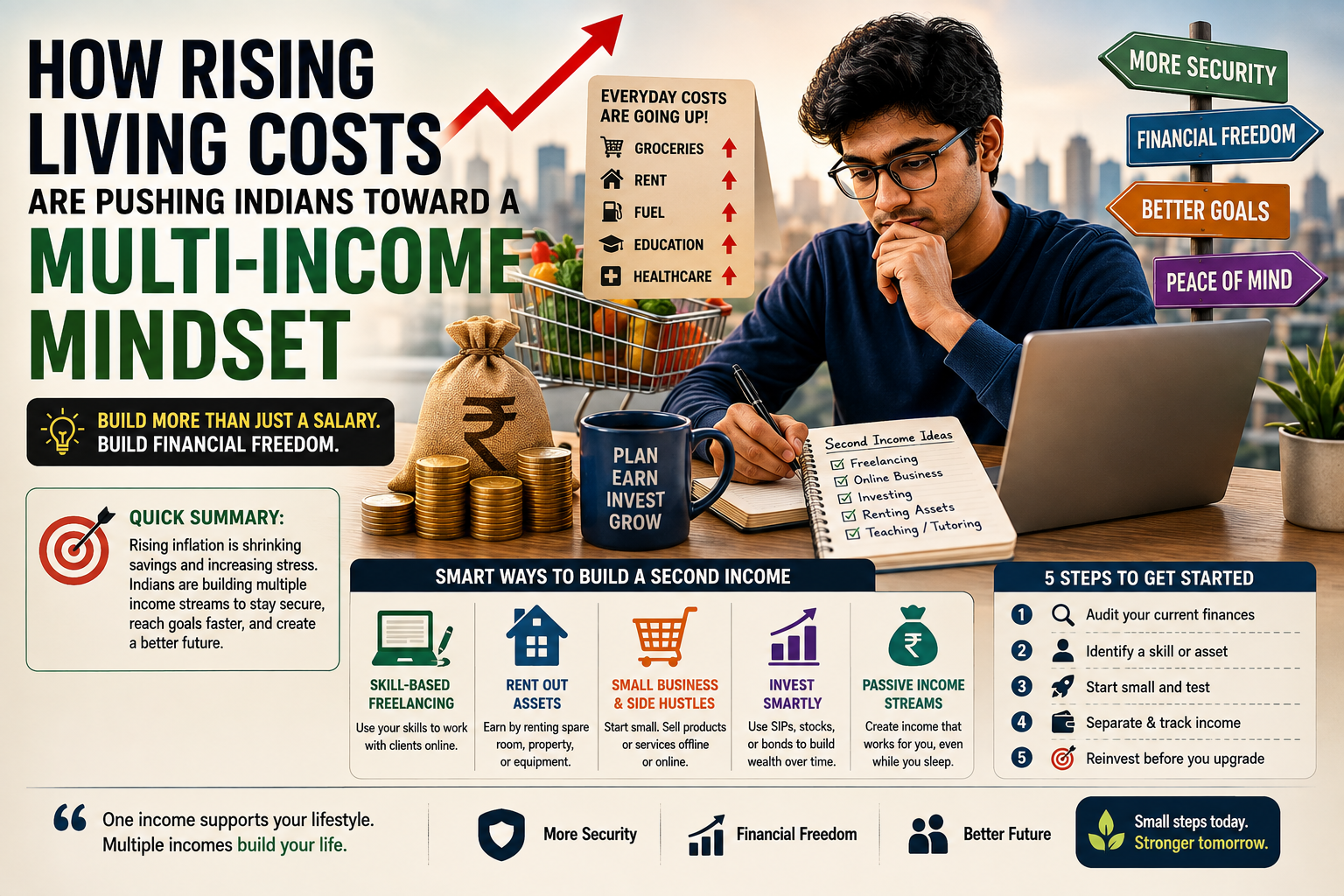
Quick summary: Rising living costs in India driven by inflation in essentials like food, housing, and education are making a single salary feel less secure than it once did. As a result, Indians are increasingly building second income streams through side hustles, freelancing, investing, and small businesses to protect their finances and reach their goals faster. This isn’t about greed or hustle culture; it’s about financial resilience in an unpredictable economy.
Why a Single Income No Longer Feels Safe
There was a time when a stable job with a fixed monthly salary felt like enough. You’d budget carefully, save a portion, and life would more or less balance out. That equation has quietly broken down for a lot of households.
Think about a mid-level employee in Bengaluru or Pune earning what feels like a “good” salary on paper. By the time rent, a child’s school fees, monthly groceries, transport, and insurance premiums are paid, there’s often very little left to save let alone invest for long-term goals like retirement or a child’s higher education.
This isn’t laziness or poor budgeting. It’s simple math. When your expenses grow faster than your income, something has to give. For many families, that “something” is the realization that one income stream, however stable it feels, is also a single point of failure.
The Real-World Trigger Points
A few common situations tend to push people toward thinking about additional income:
- A sudden medical expense that eats into months of savings
- A job layoff or hiring freeze in the industry
- Rent or EMI hikes that outpace annual salary increments
- The birth of a child, which brings new recurring costs
- Watching peers build wealth through side income while relying solely on a job feels increasingly risky
None of these are rare events anymore. They’re common enough that financial planners frequently mention having a backup income stream as a basic form of protection, similar to how an emergency fund protects against short-term shocks.
What “Multi-Income Mindset” Actually Means
A multi-income mindset isn’t about quitting your job or chasing get-rich-quick schemes. At its core, it simply means not depending entirely on one source of money to meet your goals and emergencies.
This could look very different depending on a person’s skills, time, and risk appetite:
- Skill-based freelancing -a graphic designer taking on weekend projects, a content writer picking up freelance assignments, or a software developer building small apps on the side
- Passive or semi-passive income – renting out a spare room, earning dividends from stocks, or interest from fixed deposits and bonds
- Small-scale business – selling homemade products online, running a local tuition class, or reselling goods through social media
- Investing systematically – using tools like SIPs (Systematic Investment Plans) in mutual funds to let money work alongside your job
The idea isn’t to spread yourself too thin. It’s to build one or two additional, manageable income streams that add real financial cushioning.
A Practical Example
Consider a schoolteacher in Chennai earning a modest but stable salary. A few years ago, her salary comfortably covered household expenses with room to save. As tuition costs, transport, and daily expenses gradually crept up, that saving margin shrank.
Instead of panicking, she started taking two private tuition students in the evenings something well within her expertise. This didn’t replace her main job; it simply added a second, smaller income stream that covered the gap inflation had created. Over time, she also began a modest SIP with part of that additional income, turning short-term relief into a long-term habit.
This kind of story is common. It’s rarely about dramatic career changes it’s about small, deliberate additions that build financial breathing room.
Why This Shift Makes Financial Sense
From a personal finance standpoint, relying on multiple income sources aligns with a principle most financial advisors already recommend: diversification. Just as it’s risky to put all your investments into one stock, it’s risky to depend entirely on one employer or one industry for your income.
A second income stream can help with:
- Building an emergency fund faster, without cutting into your primary salary
- Reducing debt stress, especially EMIs that feel tighter every year
- Creating investment capital for long-term goals like retirement or children’s education
- Providing a cushion during job transitions, layoffs, or health issues
It’s worth being realistic here a side income won’t fix every financial problem overnight, and not every extra rupee earned should be seen as “free money.” Time, effort, and sometimes small upfront costs go into building these income streams.
How to Start Building a Second Income Stream
If the idea appeals to you but feels overwhelming, it helps to break it down into manageable steps.
Step 1: Audit Your Current Finances
Before adding income, understand where your existing money goes. A simple monthly expense list often reveals surprising leaks subscriptions, impulse spending, or unnecessarily high EMIs.
Step 2: Identify a Skill or Asset You Already Have
You don’t need to learn something entirely new. Many people already have marketable skills writing, teaching, cooking, design, coding, or even organizing that can be monetized in small ways.
Step 3: Start Small and Time-Bound
Rather than committing to a big venture, try a small, low-risk version first. A few freelance projects, a handful of online sales, or a modest SIP amount lets you test the waters without financial strain.
Step 4: Separate and Track the Additional Income
Keep your side income separate from your main salary account, at least mentally. This makes it easier to direct it toward specific goals savings, investments, or debt repayment rather than letting it blend into everyday spending.
Step 5: Reinvest Before You Upgrade Your Lifestyle
It’s tempting to treat extra income as extra spending money. A more sustainable approach is to direct a good portion of it toward savings or investments first, and only then enjoy a modest lifestyle upgrade.
A Word of Caution
Not every income opportunity is worth pursuing. Be wary of schemes promising guaranteed high returns with little effort these often carry hidden risks or are outright scams. Genuine additional income, whether through freelancing, a small business, or investing, tends to grow steadily rather than overnight.
This article is for general informational purposes and reflects common personal finance principles. It is not personalized financial advice. For decisions involving significant sums, taxation, or investments, consulting a certified financial advisor is recommended.
Frequently Asked Questions
Q1: Is a multi-income mindset only for people struggling financially? No. Even financially comfortable individuals build additional income streams to accelerate goals like early retirement, buying property, or funding education, not just to cope with financial stress.
Q2: How much time does a second income stream usually require? It varies widely. Passive investments like SIPs need very little ongoing time, while freelancing or a small business may need several hours a week. Start with something that fits realistically into your current schedule.
Q3: Will a side income affect my main job? Not if managed sensibly. Most people choose side income options that don’t conflict with their employment terms and can be done outside work hours. It’s worth checking your employment contract for any restrictions.
Q4: What’s the safest way to start building a second income? For most beginners, starting with a skill they already have freelancing, tutoring, consulting combined with a small, consistent SIP investment offers a balanced mix of active and passive income with manageable risk.
Rising costs aren’t going away anytime soon, but your financial plan doesn’t have to depend on hoping they do. Pick one realistic income idea from this article even something small and take the first concrete step toward it this week.