Have you ever opened your trading app just because your cousin’s WhatsApp status screamed “ETFs are the new FD” and felt that instant panic of “Wait, am I missing out on something big?”
That flutter in your stomach half excitement, half fear of missing out is exactly what’s driving thousands of Indian investors to search for ETFs right now.
Key Takeaway (Read This First)
ETF demand in India has genuinely picked up pace over the last few years, driven by lower costs, easier access through apps, and growing awareness among first-time investors. But a headline number like “782% growth” usually describes a specific fund category or a short time window, not a universal guarantee of future returns. The smart move is to understand what ETFs actually do before chasing the trend.
Quick Answer
ETFs (Exchange Traded Funds) are baskets of stocks or bonds that trade on the stock exchange like a single share. They’re popular because they’re low-cost, transparent, and easy to buy through any demat account. You should consider ETFs if you want diversified, low-maintenance exposure to the market but they’re not a shortcut to quick riches, and demand spikes don’t mean guaranteed profits.
What Exactly Is an ETF?
An ETF, or Exchange Traded Fund, is a pool of money collected from many investors and used to buy a basket of assets usually stocks, sometimes bonds or gold which then trades on the stock exchange just like a regular share.
Think of it like a thali meal. Instead of ordering one dish (one stock) and hoping it’s good, you get a little bit of everything on one plate, cooked and served together. If one dish disappoints, the others balance it out.
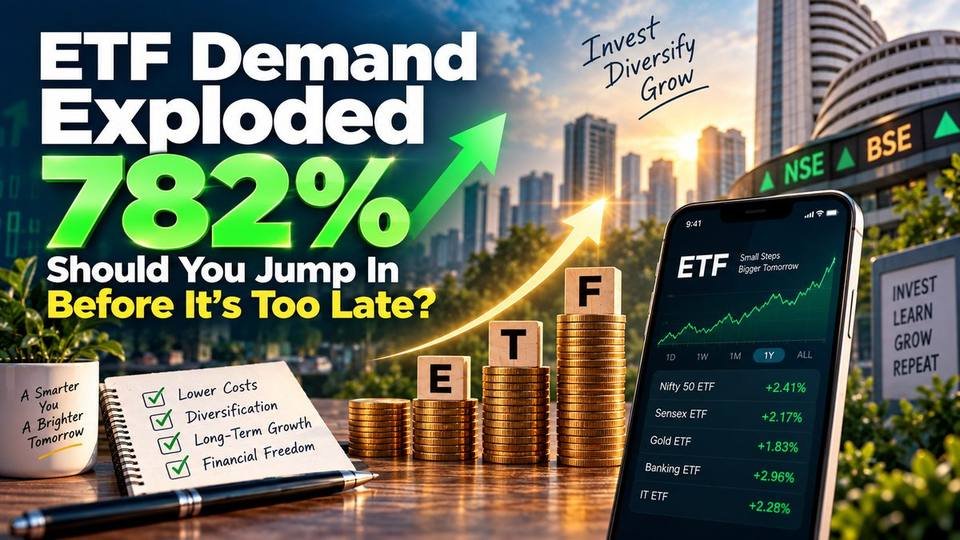
Popular examples in the Indian market include Nifty 50 ETFs, Sensex ETFs, Gold ETFs, and sector-specific ETFs like banking or IT.
Why Are Indian Investors Suddenly Rushing Into ETFs?
The short answer: cost, convenience, and confidence.
Several real shifts have made ETFs more attractive to everyday Indian investors over the past few years:
- Lower expense ratios compared to actively managed mutual funds, meaning more of your money stays invested instead of going toward fund management fees.
- Increased financial literacy, especially among salaried millennials and Gen Z investors who research before investing rather than relying only on an agent’s advice.
- Easy access through apps opening a demat account and buying an ETF today takes minutes, not weeks.
- Growing distrust of guaranteed-return schemes, pushing people toward transparent, exchange-traded products instead.
- Gold ETFs gaining traction as an alternative to buying physical gold, especially among younger investors who don’t want the hassle of lockers and making charges.
This combination naturally shows up as a sharp jump in trading volumes or new ETF folios when data providers measure demand which is often where dramatic percentage figures like “782%” originate.
Is a 782% Jump in ETF Demand Even Realistic?
Yes, sharp percentage jumps like this are possible, but context matters enormously.
A statistic like “782% growth” typically compares a small starting base to a larger recent number, or measures a very specific fund category over a short period. For example, if a niche ETF category grew from a tiny base of investors to a slightly larger group, the percentage jump can look dramatic even though the actual number of people involved is still small.
The lesson: Big percentage headlines are attention-grabbing, but they don’t tell you whether the underlying investment is right for your goals, risk appetite, or time horizon. Never invest just because a number sounds impressive on Instagram.
Should You Invest in ETFs Right Now?
Yes, ETFs are worth considering for most long-term investors, but timing your entry based on a trending headline is not a sound strategy.
Here’s a simple way to decide:
You’re a Good Fit for ETFs If You:
- Want diversified exposure without picking individual stocks
- Prefer low-cost, transparent investing
- Have a time horizon of 5+ years
- Already have an emergency fund and manageable debt
- Understand that ETF prices can fall just like stock prices
You Should Pause Before Investing If You:
- Are investing purely because “everyone is talking about it”
- Don’t have any emergency savings yet
- Are looking for guaranteed or quick returns
- Haven’t checked whether the specific ETF matches your goal (equity, gold, debt, international)
ETF vs Mutual Fund vs Direct Stocks: Quick Comparison
| Feature | ETF | Mutual Fund | Direct Stocks |
|---|---|---|---|
| Trading | Real-time on exchange | Once daily (NAV-based) | Real-time on exchange |
| Cost | Generally lower expense ratio | Higher, especially active funds | Brokerage only |
| Diversification | High (basket of assets) | High | Depends on how many stocks you hold |
| Demat account needed | Yes | No (can invest without one) | Yes |
| Best suited for | Passive, long-term investors | SIP-based disciplined investors | Investors who research individual companies |
How Much Should a Beginner Invest in ETFs?
A beginner should start small even Rs. 500 to Rs. 2,000 a month and increase the amount gradually as confidence and income grow.
There’s no fixed “correct” amount, but a practical approach many Indian financial planners recommend is:
- Build a basic emergency fund covering 3-6 months of expenses first.
- Start ETF investing with an amount you won’t need for at least 5 years.
- Treat it as one part of your portfolio, not the entire plan ideally alongside PPF, EPF, or a diversified mutual fund SIP.
- Increase your contribution as your salary increases, rather than investing a lump sum you can’t afford to lose temporarily.
Step-by-Step: How to Start Investing in ETFs in India
- Open a demat and trading account with any SEBI-registered broker.
- Complete your KYC using PAN, Aadhaar, and bank details.
- Research the ETF category decide between equity index ETFs, gold ETFs, or debt ETFs based on your goal.
- Check the expense ratio and tracking error of the specific ETF before buying.
- Place your first order just like buying a regular stock, during market hours.
- Review your portfolio quarterly, not daily ETFs are meant for long-term holding, not constant trading.
Common Mistakes Indian Investors Make With ETFs
- Chasing trending ETFs without understanding what they track
- Ignoring liquidity some niche ETFs have low trading volumes, making it harder to exit at a fair price
- Confusing ETFs with individual stock trading and checking prices obsessively
- Not comparing expense ratios across similar ETFs before choosing one
- Putting in a lump sum right after a “demand explosion” headline instead of investing gradually
A Realistic Scenario
Consider Priya, a 27-year-old marketing professional in Bengaluru. She read a headline about ETF demand skyrocketing and immediately wanted to invest her entire bonus in one go. Instead, she paused, opened a demat account, started with Rs. 3,000 a month in a Nifty 50 ETF, and kept her existing mutual fund SIPs running alongside it. A year later, she hadn’t gotten rich overnight, but she had built a disciplined habit and diversified her portfolio without panic-buying based on a single headline.
This is the difference between reacting to noise and building a strategy.
Frequently Asked Questions
Is it safe to invest in ETFs in India? ETFs are regulated by SEBI and traded on recognized stock exchanges, making them a transparent and relatively safe investment vehicle. However, like all market-linked products, their value can go up or down, so “safe” doesn’t mean risk-free.
Are ETFs better than mutual funds for beginners? ETFs often have lower costs and more transparency, but they require a demat account and some understanding of how to place trades. Beginners who prefer automated, disciplined investing without managing a demat account may find regular mutual fund SIPs easier to start with.
Can I lose money in ETFs? Yes. Since ETFs track the value of underlying stocks, bonds, or gold, their price moves with the market. A market downturn will reduce the value of your ETF holdings just as it would with direct stock investments.
What is the minimum amount needed to invest in an ETF in India? There’s no fixed minimum beyond the price of one unit of the ETF, which can be as low as a few hundred rupees, making it accessible even for beginners with limited capital.
A Quick Disclaimer
This article is for educational purposes only and does not constitute personalized financial advice. Market-linked investments, including ETFs, are subject to risk, and past growth or demand trends do not guarantee future performance. Please assess your own financial goals or consult a registered financial advisor before investing.
Your Next Step
Don’t wait for the next viral headline to decide your investment move. Open your demat account this weekend, pick one simple index ETF that matches your goal, and start with an amount you’re genuinely comfortable investing every month not the amount trending on social media.